Sung Kwang Bend Shares Fall 24% as Q3 Swings to an Operating Loss
Sung Kwang Bend, a KOSDAQ maker of pipe fittings for LNG and plant projects, fell 24.3% on Nov. 6, 2026, after a 33% drop in Q3 revenue left it in the red.
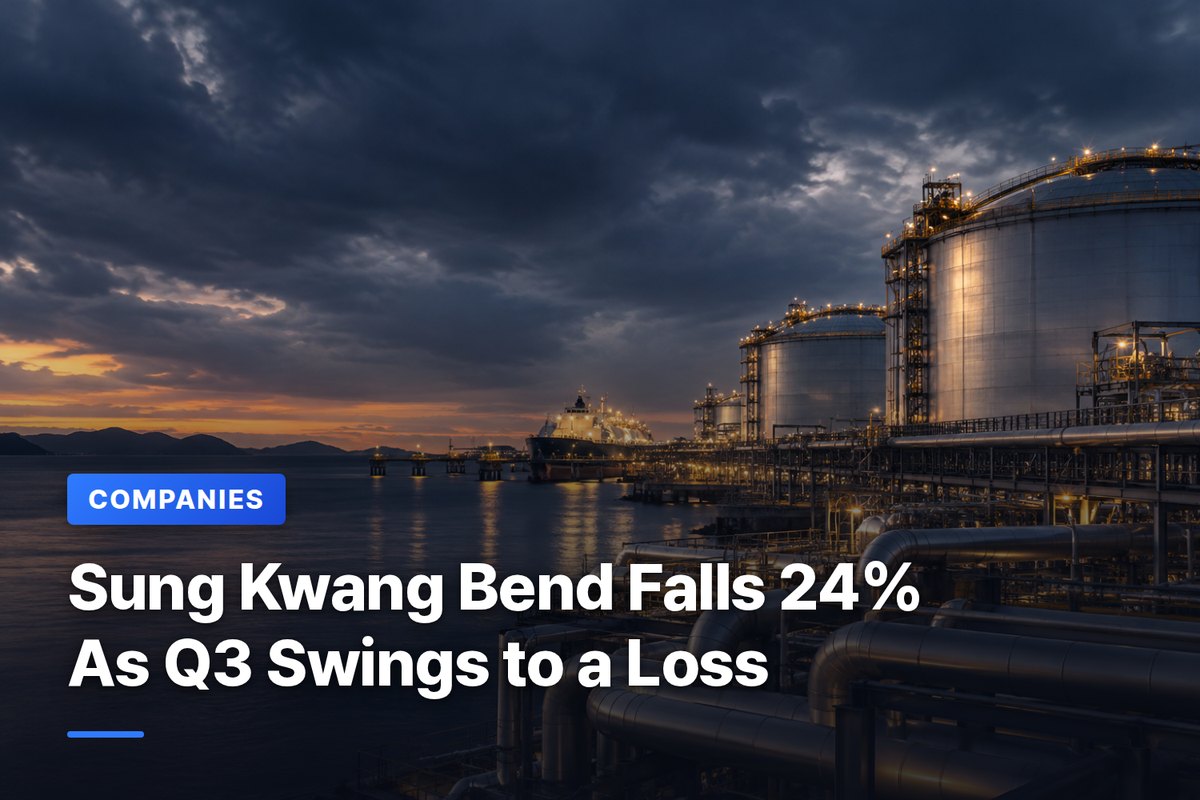
Shares of Sung Kwang Bend fell 24.3% to ₩21,500 on Nov. 6, 2026, after the Busan-based maker of industrial pipe fittings reported an operating loss for the third quarter. The fall erased about ₩183 billion ($135 million) of market value on a day when the KOSDAQ index, where the company trades under code 014620, dropped 5.03%.
The result matters beyond a single quarter because Sung Kwang Bend is an export business tied to energy investment. Exports made up 71% of its revenue in the first half of 2026, and Korean brokerages had named it a beneficiary of LNG and natural gas spending in North America.
Revenue fell 33.2% from the previous quarter to ₩42.8 billion ($31.6 million) in July–September 2026, according to a preliminary filing the company posted on DART, Korea's electronic disclosure system, at 10:12 a.m. in Seoul. It booked an operating loss of ₩1.2 billion ($0.9 million), compared with operating profits of ₩10.0 billion ($7.4 million) in Q2 2026 and ₩11.7 billion ($8.6 million) in Q3 2025.
Dollar amounts in this article are converted at ₩1,356.6 per dollar, the won's rate at 3:30 p.m. in Seoul on Nov. 6, 2026, as reported by Yonhap.
| Quarter | Revenue | Operating profit | Operating margin | Net profit |
|---|---|---|---|---|
| Q3 2025 | ₩64.6 bn ($47.6 mn) | ₩11.7 bn ($8.6 mn) | 18.2% | ₩10.8 bn ($7.9 mn) |
| Q4 2025 | ₩59.3 bn ($43.7 mn) | ₩8.7 bn ($6.4 mn) | 14.7% | ₩8.0 bn ($5.9 mn) |
| Q1 2026 | ₩59.1 bn ($43.6 mn) | ₩6.6 bn ($4.8 mn) | 11.1% | ₩8.4 bn ($6.2 mn) |
| Q2 2026 | ₩64.1 bn ($47.3 mn) | ₩10.0 bn ($7.4 mn) | 15.6% | ₩9.6 bn ($7.1 mn) |
| Q3 2026 | ₩42.8 bn ($31.6 mn) | –₩1.2 bn (–$0.9 mn) | –2.7% | –₩6.1 bn (–$4.5 mn) |
Consolidated preliminary figures from the company's DART filings of May 8 and Nov. 6, 2026; margins are calculated from them.
The damage grew below the operating line. Sung Kwang Bend reported a pre-tax loss of ₩8.2 billion ($6.0 million) and a net loss of ₩6.1 billion ($4.5 million), so about ₩7.0 billion ($5.2 million) of the pre-tax loss came from items outside its core business. In Q2 2026, the same items had added ₩2.5 billion ($1.8 million) to profit.
The filing does not say what those items were. "This disclosure has not completed the external auditor's review and may change in the course of that review," the company said in the filing (translated from Korean).
Why the Shares Fell
The whole market was selling that Friday. The KOSPI fell 6.02% to 5,059.69 and the KOSDAQ lost 5.03% to 644.27, as fears grew that the U.S. midterm election results would bring tighter regulation of data centers, the Financial News reported. A circuit breaker halted KOSPI trading early in the session, and a sidecar, a temporary curb on program selling, was triggered on the KOSDAQ.
Sung Kwang Bend fell almost five times as far as its index. Its high for the day, ₩27,400, was 3.5% below the previous close of ₩28,400, so the stock was already lower when the results came out. It touched ₩20,000 during the session, 29.6% below the previous close and near the 30% daily limit on Korean stocks, before ending at ₩21,500.
Shares worth ₩18.8 billion ($13.9 million) changed hands, according to market data from the Korea Economic Daily, and the close left the stock 59.7% below its 52-week high of ₩53,300. Our guide on how to buy Korean stocks from abroad explains the daily limit and Korea's trading hours.
The earnings filing added company-specific pressure. From Q2 to Q3 2026, revenue dropped by ₩21.3 billion ($15.7 million) while operating profit dropped by ₩11.2 billion ($8.2 million), so more than half of the lost sales came straight out of operating profit. The filing gives no reason for the drop in sales.
The company has warned that its sales are hard to predict. "Because this is an industry where production and sales are made to order, demand is difficult to forecast," Sung Kwang Bend said in its half-year report, filed on Aug. 14, 2026 (translated from Korean).
Earnings Per Share
Sung Kwang Bend earned ₩1,270 ($0.94) per share in 2025, down 12% from ₩1,438 in 2024, according to FnGuide data on Naver Finance. Earnings per share (EPS) is net profit attributable to shareholders divided by the share count.
EPS was ₩317 in the first quarter of 2026 and ₩361 in the second, or ₩678 ($0.50) for the half. The Q3 net loss of ₩6.1 billion works out to a loss per share of about ₩229 ($0.17), against EPS of roughly ₩406 a year earlier, by our calculation using the share count implied by the Q2 figures.
Adding the last four quarters gives trailing EPS of about ₩751 ($0.55). At ₩21,500, that is 28.6 times trailing earnings, against 16.9 times 2025 EPS and 14.7 times the FnGuide consensus of ₩1,458 ($1.07) for 2026. The consensus assumed Q3 net profit of ₩10.5 billion rather than a loss, so the forward P/E (price-to-earnings ratio) looks lower than it is likely to be.
What Sung Kwang Bend Makes
The company makes butt-welding pipe fittings: elbows that turn a pipeline, tees that split it and reducers that change its diameter. Its fittings go into petrochemical plants, ships and offshore platforms, power plants and LNG facilities.
Sung Kwang Bend was incorporated in 1980 and has traded since January 2001 on KOSDAQ, the Korea Exchange's market for smaller and mid-sized companies. Its one subsidiary, Hwajin PF, makes similar fittings.
Revenue was ₩245.7 billion ($181.1 million) in 2025 and ₩123.3 billion ($90.9 million) in the first half of 2026, when exports brought in ₩87.9 billion ($64.8 million). At the Nov. 6 close, the company's 26.56 million shares were worth about ₩571.0 billion ($420.9 million). Its main domestic rival is Tae Kwang Corporation, and the Korea Economic Daily describes the pair as the two leaders of Korea's pipe-fitting market.
The largest recent order came from Canada. In August 2026, Sung Kwang Bend won a ₩25.5 billion ($18.2 million) order for stainless steel butt-welding fittings from JGC Fluor BC LNG II JV, for the second phase of a Canadian LNG project that the filing calls LNGC Phase 2. The dollar figure is the contract's own value, which the company converted at ₩1,402.50 per dollar, the rate on Aug. 20, 2026.
Deliveries run until April 21, 2027, and the order equals 10.38% of the company's 2025 revenue. "The contract amount and contract period may change depending on the progress of construction," the filing said (translated from Korean).
A Buyback Days Before the Loss
The company finished buying back its own shares two days before the results. Under a ₩5.0 billion ($3.7 million) trust contract with Samsung Securities, approved by the board on Oct. 1, 2026, it bought 176,822 shares, or 0.67% of the total, by Oct. 31 at an average of about ₩28,277 each. It ended the trust early on Nov. 4 because the purchase was complete.
At the Nov. 6 close, those shares were worth 24% less than the company paid. The Nov. 4 filing said the shares would be moved into the company's own securities account; it did not say whether they would be cancelled.
The buyback was part of a value-up plan that the board approved on Jan. 12, 2026. For 2026 to 2028, the plan targets a price-to-book ratio of at least 1, a return on equity of 10% and a shareholder return ratio of 30% or more each year. The company pledged to "carry out share buybacks and cancellations in each year from 2026 to 2028 and expand cash dividends" to reach that ratio (translated from Korean).
Korea context: Korea's government unveiled the Corporate Value-up Program in February 2024 to address the "Korea discount," the tendency of Korean shares to trade at lower valuations than peers abroad. Listed companies are encouraged, on a voluntary basis, to draw up value-up plans every year and disclose them to the Korea Exchange, according to the Financial Services Commission. Sung Kwang Bend's market value of ₩571.0 billion at the Nov. 6 close was close to its equity of ₩562.0 billion ($414.3 million) at June 30, 2026, which puts its price-to-book ratio near the plan's floor of 1.
What Analysts Said Before the Loss
Hyundai Motor Securities began covering the stock on March 20, 2026, with a Buy rating and a ₩45,000 target, more than double the Nov. 6 close, the Asia Business Daily reported. "Pipeline construction is essential not only at LNG production facilities but also at import terminals," said Shin Dong-hyun, a researcher at the firm (translated from Korean). The firm expected margins to rise because LNG liquefaction plants mainly use stainless steel fittings, which earn higher profits.
On Oct. 28, 2026, Shinyoung Securities named Sung Kwang Bend and Tae Kwang as beneficiaries of growing natural gas investment in North America, the Korea Economic Daily reported. As of Oct. 22, Sung Kwang Bend traded at 13.5 times expected earnings for the next 12 months against 7.8 times for Tae Kwang, Korea Investment & Securities calculated. That was the widest gap between the two since 2007, the firm's analyst said, according to Money Today.
Those views came before the third-quarter loss. The balance sheet leaves room to absorb it: at June 30, 2026, the company held ₩140.3 billion ($103.4 million) in cash and other short-term financial assets against total liabilities of ₩38.2 billion ($28.2 million). Inventory, at ₩148.5 billion ($109.5 million), exceeded its first-half revenue.
What to Watch
The full quarterly report comes first. Korea's capital markets law gives listed companies 45 days after a quarter ends to file it, which puts Sung Kwang Bend's report in mid-November 2026. It should break down the ₩7.0 billion of non-operating losses and the fall in sales.
The Canadian contract is the second item, since the company bills the buyer as deliveries progress through April 21, 2027. The third is whether the board decides to cancel the 176,822 repurchased shares, as the value-up plan promises for each year through 2028.
Taken together, Sung Kwang Bend's third quarter showed how fast a made-to-order fittings maker can swing when shipments slip, while its Canadian order and ₩140.3 billion of cash and short-term assets give it a cushion. The next dated check is the quarterly report due in mid-November 2026, followed by the final delivery date of the Canadian contract on April 21, 2027.
Sources
- dart.fss.or.kr/dsaf001/main.do
- dart.fss.or.kr/dsac001/mainK.do
- dart.fss.or.kr/dsaf001/main.do
- dart.fss.or.kr/dsaf001/main.do
- dart.fss.or.kr/dsaf001/main.do
- dart.fss.or.kr/dsaf001/main.do
- dart.fss.or.kr/dsaf001/main.do
- dart.fss.or.kr/dsaf001/main.do
- dart.fss.or.kr/dsaf001/main.do
- markets.hankyung.com/stock/014620
- www.fnnews.com/news/202611061559461085
- www.koreaherald.com/article/10928775
- view.asiae.co.kr/article/2026032009261711122
- www.hankyung.com/article/202610280523i
- www.mt.co.kr/stock/2026/10/26/2026102608235654993
- www.fsc.go.kr/eng/pr010101/81778
- global.krx.co.kr/contents/GLB/06/0602/0602010201/GLB0602010201T5.jsp
- elaw.klri.re.kr/eng_service/lawTwoView.do
- finance.naver.com/item/main.naver