Kumho Petrochemical Falls 16.5% on First Quarterly Loss Since 2015
Kumho Petrochemical fell 16.5% on Nov. 6, 2026 after a ₩20.8 billion Q3 operating loss, three months after earning ₩339 billion. Here is why.
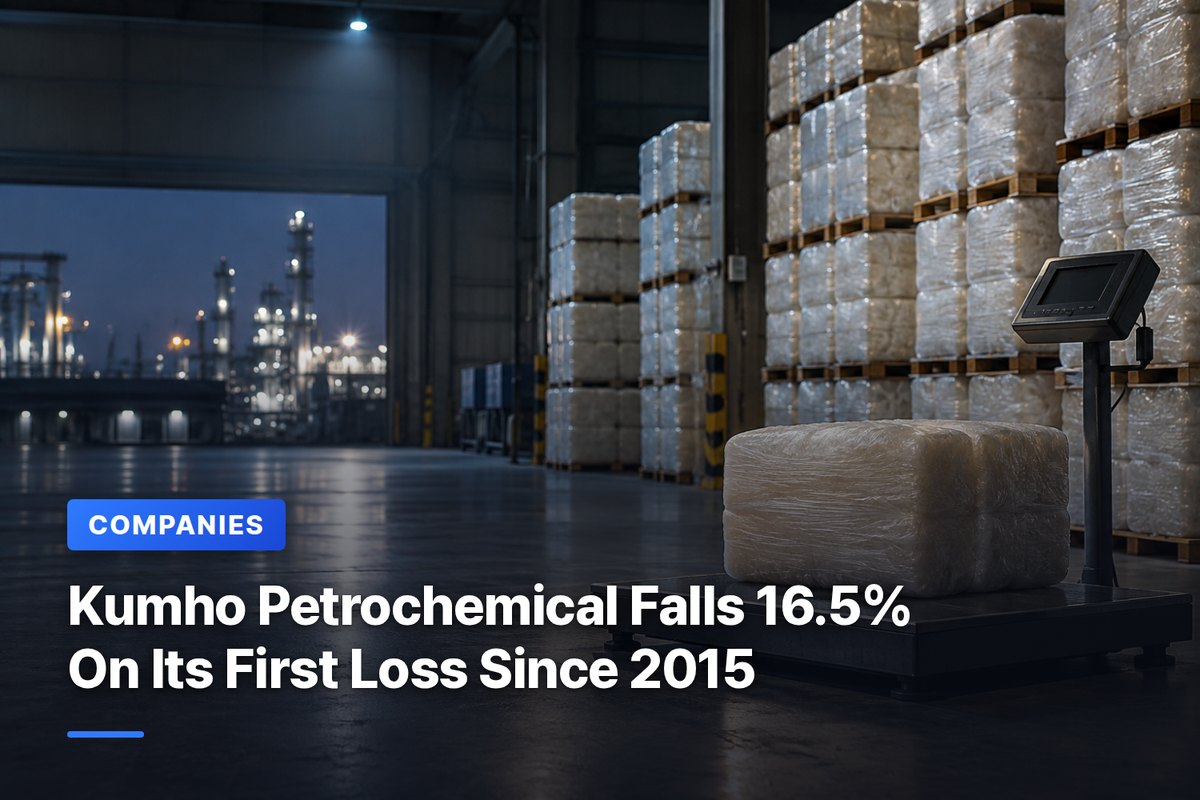
Kumho Petrochemical shares fell 16.5% on Nov. 6, 2026, the day the Korean synthetic rubber maker reported a third-quarter operating loss of ₩20.8 billion ($15.4 million). Three months earlier, it had posted an operating profit of ₩339.0 billion ($249.9 million) for the second quarter.
The stock ended regular trading at ₩93,400 ($68.85), down from ₩111,900 ($82.49), according to the 3:30 p.m. price shown by Asia Business Daily. It was the company's first quarterly operating loss since the fourth quarter of 2015, Hankyung and MoneyToday reported.
Kumho Petrochemical trades on the KOSPI, the main board of the Korea Exchange, under the code 011780. Its common shares were worth about ₩2.33 trillion ($1.72 billion) at the close, by our calculation. Won amounts here are converted at ₩1,356.6 per dollar, the won's 3:30 p.m. rate in Seoul on Nov. 6, 2026, as reported by the Korea Herald.
| Quarter | Revenue | Operating profit | Operating margin | Net profit to shareholders |
|---|---|---|---|---|
| Q3 2025 | ₩1.64 trillion ($1.21 billion) | ₩84.4 billion ($62.2 million) | 5.1% | ₩106.9 billion ($78.8 million) |
| Q4 2025 | ₩1.59 trillion ($1.17 billion) | ₩1.6 billion ($1.1 million) | 0.1% | ₩1.4 billion ($1.0 million) |
| Q1 2026 | ₩1.78 trillion ($1.31 billion) | ₩59.4 billion ($43.8 million) | 3.3% | ₩96.3 billion ($71.0 million) |
| Q2 2026 | ₩2.27 trillion ($1.67 billion) | ₩339.0 billion ($249.9 million) | 14.9% | ₩300.4 billion ($221.4 million) |
| Q3 2026 | ₩1.92 trillion ($1.42 billion) | -₩20.8 billion (-$15.4 million) | -1.1% | -₩22.0 billion (-$16.3 million) |
The figures come from the company's preliminary filings on DART, Korea's electronic disclosure system. Revenue rose 16.9% from a year earlier but fell 15.3% from the second quarter, and the net loss attributable to shareholders was ₩22.0 billion ($16.3 million).
The miss was large. FnGuide consensus data on Naver Finance had pencilled in an operating profit of ₩82.9 billion ($61.1 million) for the quarter, and Hankyung called the result an "earnings shock."
One quarter does not tell the whole story, though. Operating profit for the first nine months of 2026 was ₩377.6 billion ($278.3 million), up 39.7% from a year earlier and already above the ₩271.8 billion ($200.4 million) the company earned in all of 2025.
What Negative Lagging Means
The company blamed most of the loss on what Korean chemical makers call "negative lagging." The loss was the result of "a narrowing spread from negative lagging caused by high-cost inventories of key raw materials and products," the company said, according to the Seoul Economic Daily (translated from Korean).
Here's what that means. A chemical maker buys raw materials, holds them as inventory, and turns them into products that are sold some time later. Its profit depends on the spread, the gap between what it pays for raw materials and what it charges for products.
The timing matters. If the company stocked up while raw materials were expensive, and product prices have fallen or stayed flat by the time those goods are sold, the old, expensive inventory flows into costs while revenue reflects the weaker market.
Simply put, negative lagging is a company selling at prices it no longer controls, using materials it paid too much for. The reverse, a "positive lagging" effect, lifts margins when product prices rise faster than the cost of inventory already bought.
For Kumho, the key raw materials are butadiene and styrene monomer, and its product prices move with them and with market supply, its half-year report says. Synthetic rubber, made from those materials, accounted for 62.8% of the parent company's revenue in the first half of 2026.
Where the Quarter Went Wrong
The same Middle East shock helped one quarter and hurt the next. In the second quarter, the war between the United States and Iran widened spreads and customers rushed to secure supply, Edaily reported on Aug. 7, 2026.
"In the second quarter, we were able to post good results as the spread widened due to the U.S.-Iran war," a company official said at the time, according to Edaily (translated from Korean). The official added a warning: "From the third quarter, there are many burdensome factors, such as the spread narrowing."
That is what happened. Synthetic rubber operating profit fell 98.8% from the second quarter to ₩2.3 billion ($1.7 million), and its margin dropped from 19.2% to 0.3%, Edaily reported on Nov. 6, 2026.
Kumho had bought feedstock at prices pushed up by the Middle East conflict but could not pass those costs on because of price competition with Chinese rivals, Hankyung reported. Nitrile butadiene latex, the raw material for nitrile medical gloves, swung to a loss as competition intensified and spreads narrowed, according to MoneyToday.
| Segment | Q3 2026 revenue | Q3 2026 operating profit | Q2 2026 operating profit |
|---|---|---|---|
| Synthetic rubber | ₩782.4 billion ($576.8 million) | ₩2.3 billion ($1.7 million) | ₩189.8 billion ($139.9 million) |
| Phenol derivatives | ₩432.1 billion ($318.5 million) | -₩62.5 billion (-$46.1 million) | ₩55.1 billion ($40.6 million) |
| Synthetic resins | ₩311.5 billion ($229.6 million) | -₩13.9 billion (-$10.2 million) | ₩37.4 billion ($27.6 million) |
| EPDM and TPV | ₩210.4 billion ($155.1 million) | ₩24.3 billion ($17.9 million) | about ₩47 billion ($35 million) |
| Energy, fine chemicals, other | ₩185.1 billion ($136.4 million) | ₩29.0 billion ($21.4 million) | ₩9.3 billion ($6.9 million) |
The segment figures were reported by Edaily and MoneyToday from the company's results; they add up to the totals in the DART filing. The second-quarter EPDM figure is derived from Edaily's report of a 48.7% quarterly drop.
The biggest loss came from phenol derivatives, made by the subsidiary Kumho P&B Chemicals. Weak demand from customer industries slowed the sale of inventory, and negative lagging narrowed spreads further, Edaily reported. Synthetic resins lost money as demand for ABS plastic, used in appliances and car parts, stayed weak.
Two businesses held up. EPDM and TPV, specialty rubbers used mainly in cars, earned ₩24.3 billion, up 20.3% from a year earlier, MoneyToday reported. The energy business improved from the second quarter as Korea's wholesale power price rose, according to the same report.
Why the Shares Fell So Hard
The results landed on a day the whole market was falling. The KOSPI plunged 8.78% shortly after the open, triggering a circuit breaker, and closed down 6.02% at 5,059.69, the Korea Herald reported. Fear of tighter U.S. rules on AI data center construction after the midterm elections drove the sell-off. For more on that day, see our report on the KOSPI's 6% fall on Nov. 6.
Kumho fell about 2.7 times as much as the index. Volume was 191,635 shares, according to Asia Business Daily's market data.
Some price feeds show a lower number. The stock last traded at ₩92,500 ($68.19), down 17.34%, after further trading in the after-hours session, Hankyung market data shows. The official close is the 3:30 p.m. price of ₩93,400. For trading hours, see our guide to Korean stock market hours.
At ₩93,400, the shares stood about 42% below their 52-week high of ₩162,300 ($119.64), according to Hankyung.
Earnings Per Share
Kumho reported basic earnings per share (EPS) of ₩11,300 ($8.33) for 2025, down 15.2% from ₩13,328 in 2024, according to its annual report. EPS is net profit attributable to shareholders divided by the average number of shares outstanding.
The first half of 2026 was much stronger. Basic EPS was ₩15,530 ($11.45) for the six months, up 120% from ₩7,046 a year earlier, and ₩11,780 ($8.68) for the second quarter alone, the half-year report shows.
The third quarter reversed that. Dividing the ₩22.0 billion net loss attributable to shareholders by about 25.3 million common and preferred shares outstanding gives a loss per share of about ₩870 ($0.64), by our calculation, compared with a profit a year earlier. The quarterly report will give the official figure.
FnGuide data on Naver Finance shows lower per-share numbers: ₩13,880 for 2023, ₩11,321 for 2024, ₩9,843 for 2025 and ₩10,658 for the second quarter of 2026. By our calculation, the second-quarter figure equals net profit divided by all 28.18 million issued shares, including treasury shares the company holds itself, which is why it runs below the company's own EPS.
At the Nov. 6 close of ₩93,400, the stock traded at 8.3 times the company's 2025 EPS, or 9.5 times FnGuide's 2025 figure. FnGuide's consensus EPS for 2026 is ₩18,869 ($13.91), which puts the forward price-to-earnings ratio (P/E) at 4.9. The data does not show how many brokerages are behind the estimate.
That forward P/E needs a caveat. The FnGuide data still listed the third quarter as an estimate: EPS of ₩2,736 ($2.02), built on net profit of ₩77.1 billion ($56.8 million), when the company actually lost ₩22.0 billion.
To reach the ₩534.1 billion ($393.7 million) net profit behind the 2026 consensus, Kumho would now need about ₩159.5 billion in the fourth quarter, versus about ₩60 billion the estimate had implied for that quarter, by our calculation. Until analysts revise, the forward P/E likely looks cheaper than it is.
What Kumho Petrochemical Makes
Kumho Petrochemical makes synthetic rubbers such as SBR, BR, NBR and latex, which go into tires, shoes, car parts and medical gloves. It also makes synthetic resins such as PS and ABS, fine chemicals for rubber processing, carbon nanotubes, and steam and electricity, its half-year report shows.
Subsidiaries add phenol and BPA, specialty rubber, port operations and resorts. Exports made up 72.2% of the parent company's revenue in the first half of 2026, by our calculation from the report.
Founded on Dec. 10, 1976, the company listed on the Korea Exchange on Jan. 22, 1988, and is based in Seoul. Park Chul-wan, a member of the founding family, was the largest shareholder with 10.33% on June 30, 2026, and he and related parties held 30.19% together.
Korea context: Kumho has two listed share classes: voting common shares (011780) and non-voting preferred shares (011785). Its annual report says the preferred shares rank equally with common shares for dividends, so it counts them in EPS. Under its plan for Korea's "value-up" program, a government push for listed companies to publish targets for returns and payouts, Kumho aims to return 40% of profit to shareholders through dividends and share cancellations for fiscal 2024 to 2026, and targets return on equity of 7% by 2026. It cancelled 237,628 shares on Sept. 29, 2026 and still held about 2.6 million treasury shares, roughly 10.5% of its common stock, by our calculation from its filings. For background, see our explainer on the value-up program.
What Analysts Say
Brokerage targets have not yet caught up with the loss. The average target price on Hankyung's consensus page was ₩172,250 ($126.97) as of Nov. 6, 2026, with a buy rating, about 1.8 times the closing price. The page does not say how many brokerages it averages.
| Date | Firm | Target price | Rating |
|---|---|---|---|
| Jan. 21, 2026 | Korea Investment & Securities | ₩165,000 ($121.63), up from ₩150,000 | Buy |
| March 18, 2026 | KB Securities | ₩160,000 ($117.94), up from ₩145,000 | Buy |
| May 8, 2026 | NH Investment & Securities | ₩190,000 ($140.06), up from ₩180,000 | Not stated |
The targets come from reports by Hankyung, Edaily and MoneyToday, and all predate the third-quarter results. "Kumho Petrochemical's key investment points, a rebound in NB latex prices and improving profitability, have started to appear," NH analyst Choi Young-kwang said in May, according to MoneyToday (translated from Korean).
Korea Investment's Lee Choong-jae pointed to longer-term demand. "A new demand market called robots may emerge in the synthetic rubber industry, where car-related demand reaches 60 to 65%," he said in January, according to Hankyung (translated from Korean).
Expectations for the sector were already slipping before the results. When brokerages cut targets across chemical stocks on Oct. 21, 2026, the reasons were the delayed cost effect of expensive raw materials, a stronger won and narrower product spreads, Hankyung reported. We found no brokerage note issued after Kumho's results as of Nov. 8, 2026.
What to Watch
Management meets investors first. Kumho will hold one-on-one meetings with domestic institutional investors in Seoul from 9 a.m. on Nov. 9, 2026, hosted by NH Investment & Securities, according to a DART filing.
Next is the full quarterly report. Korean listed companies must file it within 45 days of the quarter's end under the Capital Markets Act, which means by mid-November 2026, and it will give the official third-quarter loss per share.
The company expects some recovery. "Market demand is expected to keep slowing in the fourth quarter due to year-end inventory adjustments," a company official said, according to Hankyung (translated from Korean). The official added that profitability should improve as easing Middle East tensions reduce raw material price swings and rubber customers raise operating rates.
The test is phenol derivatives. The company expects that segment to recover as the negative lagging effect fades, MoneyToday reported, so a ₩62.5 billion loss that does not shrink would point to weak demand rather than timing.
There is also a tax audit. The Seoul Regional Tax Office's Investigation Bureau 4, which handles special audits, began an audit at Kumho's headquarters on Aug. 11, 2026, looking at deals between group companies and trademark fees, Asia Business Daily reported.
Taken together, Kumho's third-quarter loss came from timing as much as demand: costly inventory bought during the Middle East shock met weak prices, while nine-month profit is still higher than in 2025. The next dated event is the Nov. 9, 2026 investor meetings, followed by the quarterly report by mid-November.
Sources
- dart.fss.or.kr/dsaf001/main.do
- dart.fss.or.kr/dsaf001/main.do
- dart.fss.or.kr/dsaf001/main.do
- dart.fss.or.kr/dsaf001/main.do
- dart.fss.or.kr/dsaf001/main.do
- dart.fss.or.kr/dsaf001/main.do
- dart.fss.or.kr/dsaf001/main.do
- www.koreaherald.com/article/10928857
- core.asiae.co.kr/article/2026081114180047318
- markets.hankyung.com/stock/011780
- markets.hankyung.com/stock/011780/consensus
- www.hankyung.com/article/2026110615321
- www.mt.co.kr/industry/2026/11/06/2026110616535074927
- edaily.co.kr/News/Read
- m.sedaily.com/article/20111311
- www.fnnews.com/news/202611061731088676
- edaily.co.kr/News/Read
- www.mt.co.kr/stock/2026/05/08/2026050809083847058
- www.hankyung.com/article/2026012127416
- marketin.edaily.co.kr/News/ReadE
- www.hankyung.com/article/202610215806i
- elaw.klri.re.kr/eng_service/lawTwoView.do
- finance.naver.com/item/main.naver