Samsung Electronics Stock Falls 22% After a Record Q3 Profit
Samsung Electronics earned a record ₩107.4 trillion in Q3 2026, yet its shares fell 22% by Nov. 6. What drives the profit, the payout plan and analyst targets.
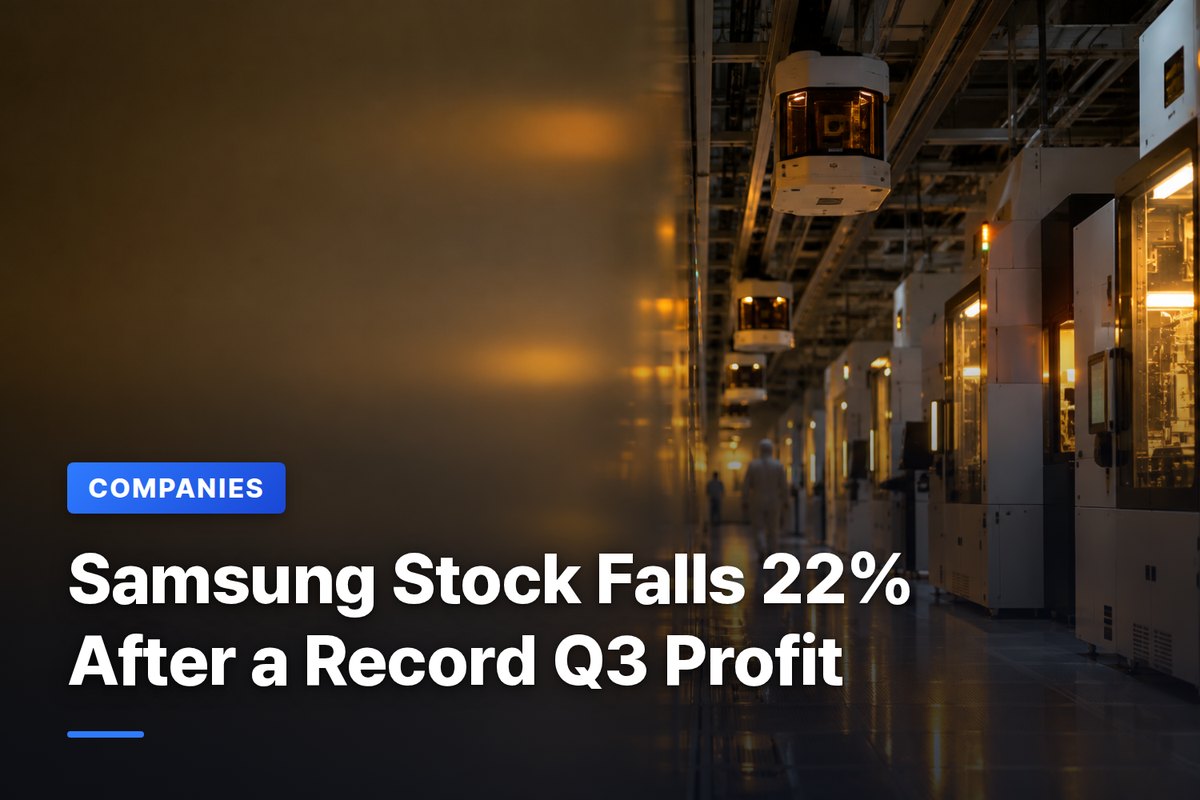
Samsung Electronics (KOSPI: 005930), the Korean maker of memory chips, Galaxy smartphones and TVs, reported the largest quarterly profit in its history on Oct. 29, 2026. Operating profit for Q3 2026 reached ₩107.44 trillion ($79.2 billion), up 783% from a year earlier, as prices kept rising for the memory chips that go into AI servers.
Investors sold anyway. The common shares closed at ₩188,700 ($139) on Nov. 6, 2026, down 22% from ₩242,000 on Oct. 28, the day before the results, and the stock has lost roughly half its value from its 2026 peak of ₩374,500, the Korea Herald reported.
Dollar figures in this article are converted at ₩1,356.6 per dollar, the Seoul rate at the 3:30 p.m. close on Nov. 6, 2026, as reported by the Korea Herald. Here is what the company does, why a record quarter met a falling share price, and what comes next.
The preliminary results Samsung filed on DART, Korea's electronic disclosure system, show how fast profit has grown in a year.
| Q3 2025 | Q2 2026 | Q3 2026 | |
|---|---|---|---|
| Revenue | ₩86.06 trillion ($63.4 billion) | ₩171.50 trillion ($126.4 billion) | ₩195.25 trillion ($143.9 billion) |
| Operating profit | ₩12.17 trillion ($9.0 billion) | ₩89.49 trillion ($66.0 billion) | ₩107.44 trillion ($79.2 billion) |
| Operating margin | 14.1% | 52.2% | 55.0% |
| Net profit | ₩12.23 trillion ($9.0 billion) | ₩71.62 trillion ($52.8 billion) | ₩75.14 trillion ($55.4 billion) |
For the first nine months of 2026, revenue totaled ₩500.63 trillion ($369.0 billion) and operating profit ₩254.17 trillion ($187.4 billion), according to the filing. The figures are unaudited, and Samsung noted that the final numbers may differ.
Memory chips did almost all of the work. The Device Solutions (DS) division, which makes chips, earned ₩106.5 trillion ($78.5 billion) of the total, and memory revenue alone came to ₩140.7 trillion ($103.7 billion), Hankyung reported.
High-bandwidth memory (HBM), a stack of DRAM chips mounted beside an AI processor, is the product investors watch most closely. On its Oct. 29 earnings call, Samsung said its latest generation, HBM4, made up about 60% of its HBM revenue, and that HBM4 revenue more than tripled from the previous quarter, the Korea Herald reported.
"Negotiations for our 2027 HBM supply have been completed at prices reflecting our product competitiveness, and the volume is already sold out," the company said on the call, according to the Korea Herald. Samsung has signed long-term memory supply agreements with 10 major customers and is negotiating with 10 more.
Kim Jae-june, a vice president in Samsung's memory business, told the call that "unprecedented strength in memory demand will continue in 2027 as well, driven by the race to build AI infrastructure and the spread of personal AI agents," Financial News reported (translated from Korean).
Samsung also guided capital spending of about ₩84.4 trillion ($62.2 billion) for 2026 in a separate filing. "Capacity expansion at advanced nodes is not keeping pace with demand," the company said, according to the Korea Herald.
Earnings Per Share
Samsung earned ₩6,564 ($4.84) of net profit per share in 2025, up 33% from ₩4,950 in 2024, according to FnGuide data on Naver Finance. Earnings per share (EPS) is net profit attributable to shareholders divided by the share count, and Samsung counts its common and preferred shares together.
The first half of 2026 alone was worth far more. EPS came to ₩6,993 in the first quarter and ₩10,718 in the second, or ₩17,711 ($13.06) for the half, 2.7 times all of 2025. Third-quarter EPS will appear in the quarterly report due in mid-November, and the preliminary filing already shows net profit about six times higher than a year earlier.
At the Nov. 6 close of ₩188,700, the shares traded at 28.7 times 2025 EPS but 4.1 times the 2026 consensus estimate of ₩45,655 ($33.65), the FnGuide average of brokerage forecasts. That estimate assumed third-quarter net profit of ₩88.35 trillion, more than the ₩75.14 trillion Samsung reported, so it may come down as analysts update their models.
What Samsung Electronics Does
Samsung Electronics is a global electronics group with 309 subsidiaries, according to its half-year report for 2026. Its Device eXperience (DX) division makes TVs, appliances, smartphones and PCs, while DS makes DRAM and NAND flash memory and mobile processors.
The group also includes Samsung Display, which makes OLED panels for smartphones, and Harman, a maker of digital cockpits for cars and audio products.
In the first half of 2026, DS booked ₩209.23 trillion ($154.2 billion) in sales, or 68.5% of the total, and DX ₩100.68 trillion ($74.2 billion), or 33%. The shares add up to more than 100% because sales between divisions are counted in each one.
Prices explain much of that split. Samsung's average memory selling price in the first half was about 220% above its 2025 average, while its average TV price fell about 4%, the report said.
In Q3 2026, the DX division lost ₩800 billion ($590 million), Samsung Display earned ₩1.1 trillion ($810 million) and Harman ₩600 billion ($440 million), the Korea Herald reported. Simply put, Samsung's profit now comes from a memory business that happens to sit beside a phone and TV maker.
Samsung was founded on Jan. 13, 1969 and went public on the Korea Exchange's main board, the KOSPI, on June 11, 1975. Its largest shareholder is Samsung Life Insurance with 8.57% of voting shares, and the National Pension Service, the state pension fund, holds 7.89%, the half-year report shows.
At ₩188,700, its 5.85 billion common shares were worth about ₩1,103 trillion ($813 billion) on Nov. 6, 2026, before counting preferred shares. Samsung and SK hynix together make up roughly half of the KOSPI's market value, the Korea Times reported, so the pair largely moves the index; our guide to the KOSPI, KOSDAQ and KOSPI 200 explains how it is built.
Why the Shares Fell After a Record Quarter
The first drop came on results day. The stock rose as high as ₩249,000 on Oct. 29, 2026, then turned lower after the results came out at 10 a.m. in Seoul and closed down 4.13% at ₩232,000, according to Financial News.
Investors had wanted a concrete buyback. "Given the high external uncertainty, the market expected the announcement of immediate measures to lift the share price, such as share buybacks and cancellations," said Ryu Hyung-geun, an analyst at Daishin Securities, according to Hankyung (translated from Korean).
The second drop came from the customer side. On Nov. 3, 2026, Oracle announced plans to raise $20 billion, half in new shares and half in bonds, to pay for AI infrastructure, and its stock fell 8.76%, Hankyung reported. Samsung fell 4.15% that day to ₩219,500 as the KOSPI lost 3.59%.
The third drop was political. After Democrats won control of both chambers of the US Congress in the midterm elections, investors worried about tighter rules on building AI data centers, the Korea Times reported. Samsung fell 7.57% to ₩201,500 on Nov. 5 and another 6.35% on Nov. 6.
Foreign investors led the selling. They sold a net ₩2.2 trillion ($1.6 billion) of Samsung shares between Nov. 2 and Nov. 6, 2026, and their stake fell to 45.95% on Nov. 6, the lowest since July 2009, the Seoul Economic Daily reported.
Most Korean companies have no ceiling on foreign ownership, as our guide to foreign ownership limits explains, so the falling stake reflects selling rather than a cap. Retail investors bought a net ₩1.9 trillion ($1.4 billion) of Samsung shares in the same week, the Seoul Economic Daily said.
Shareholder Returns and the January Decision
Samsung has said it will return ₩90 trillion to ₩110 trillion ($66 billion to $81 billion) to shareholders for 2026. About ₩35 trillion ($25.8 billion) had been paid or committed by Oct. 29, leaving ₩55 trillion to ₩75 trillion ($40.5 billion to $55.3 billion), Hankyung reported.
The company plans to settle the amount and method in late January 2027. "The return of the remaining funds will include a substantial share repurchase and cancellation program, along with cash dividends," Samsung said, according to the Korea Herald.
The Q3 dividend is already fixed. The board approved ₩4,601 ($3.39) per common and preferred share, ₩30.0 trillion ($22.1 billion) in total, for holders of record on Sept. 30, 2026, payable on Nov. 27, 2026, the DART filing shows.
That payout is more than 12 times the roughly ₩370 paid in each of the first two quarters of 2026, the Korea Times reported.
One buyback is under way but will not shrink the share count. On Aug. 21, 2026, the board approved buying ₩15 trillion ($11.1 billion) of common shares by Nov. 21, 2026, and the filing states the purpose as stock-based pay for employees.
Daishin Securities expects about ₩25 trillion ($18.4 billion) of buybacks and cancellations in the January plan if they center on preferred shares, Hankyung reported on Oct. 30, 2026.
Korea context: Samsung has two listed share classes. On June 30, 2026, it had 5.85 billion common shares and 802 million non-voting preferred shares, according to its half-year report. Both receive the same ₩4,601 Q3 dividend, but the preferred shares trade at a lower price, so the dividend filing puts their yield at 2.2%, against 1.7% on the common shares.
What Analysts Expect
Brokerage targets after the results spread widely. Five Korean brokerages reported between Oct. 30 and Nov. 3, 2026 set targets from ₩350,000 to ₩690,000, an average of ₩512,000 ($377), against the Nov. 6 close of ₩188,700.
| Brokerage | Reported | Target | Change |
|---|---|---|---|
| Yuanta Securities | Oct. 30 | ₩690,000 ($509) | Raised from ₩630,000 |
| KB Securities | Nov. 3 | ₩600,000 ($442) | Kept |
| Hana Securities | Oct. 30 | ₩480,000 ($354) | Kept |
| Korea Investment & Securities | Nov. 3 | ₩440,000 ($324) | Cut from ₩570,000 |
| IBK Securities | Oct. 30 | ₩350,000 ($258) | Cut from ₩460,000 |
KB Securities expects Samsung to earn ₩1,022 trillion ($753 billion) in operating profit across 2026 and 2027 combined. "The company's overwhelming earnings generation has made its earnings outlook much clearer," said Kim Dong-won, head of research at KB Securities, as translated by The Asia Business Daily.
KB also estimated that Samsung's share of the global HBM market rose from 21% in Q1 2026 to 33% in Q2 and 40% in Q3, the Asia Business Daily reported.
The low end of the range rests on payouts rather than chips. "Considering that the shareholder return policy falls short of market expectations and that preference for the stock may weaken against competitors, we judge that share price gains will be limited," said Kim Un-ho, an analyst at IBK Securities, according to Hankyung (translated from Korean).
Korea Investment & Securities cut its target because long-term supply contracts, at close to 70% of the mix, limit how far prices can rise, Financial News reported. The firm still estimated that average selling prices would rise 7% for DRAM and 6% for NAND in Q4 2026.
Taken together, Samsung's record quarter shows how far memory prices have carried its profit, while its share price now depends on two outside forces: US spending on AI data centers and the size of the coming buyback. The next dated markers are the Q3 dividend payment on Nov. 27, 2026 and the board's shareholder return decision in late January 2027.
Sources
- dart.fss.or.kr/dsaf001/main.do
- dart.fss.or.kr/dsaf001/main.do
- dart.fss.or.kr/dsaf001/main.do
- dart.fss.or.kr/dsaf001/main.do
- dart.fss.or.kr/dsaf001/main.do
- dart.fss.or.kr/dsaf001/main.do
- www.koreaherald.com/article/10919169
- www.koreaherald.com/article/10928857
- www.koreatimes.co.kr/business/companies/20261029/samsung-electronics-dividend…
- www.koreatimes.co.kr/economy/others/20261104/seoul-stocks-face-fresh-uncertai…
- www.koreatimes.co.kr/economy/20261105/kospi-tumbles-as-democrat-sweep-fuels-a…
- www.hankyung.com/article/202610292686g
- www.hankyung.com/article/2026110332016
- www.hankyung.com/article/2026103058897
- hankyung.com/article/2026103065586
- www.fnnews.com/news/202610300601198816
- fnnews.com/news/202611031030303405
- view.asiae.co.kr/en/article/2026110216122283749
- en.sedaily.com/finance/2026/11/08/foreigners-dump-76-trillion-won-in-samsung-…
- en.sedaily.com/news/2026/11/06/foreign-selling-of-28-trillion-won-pushes-kosp…
- finance.naver.com/item/main.naver