Korea's Move to T+1 Settlement: What Changes for Foreign Investors
Korea plans to settle stock trades in one day instead of two from as early as 2028. What it means for cash, FX deadlines, margin calls and dividends.
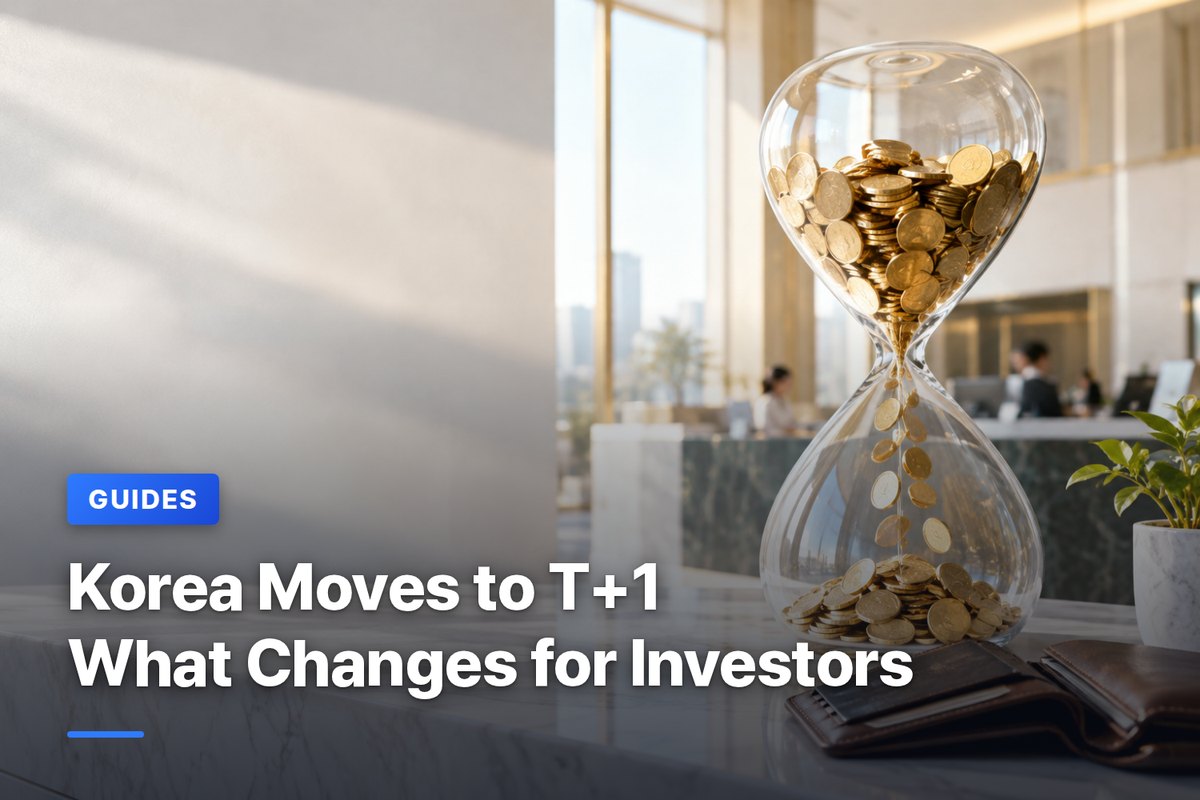
Korea plans to cut the time it takes to settle a stock trade from two business days to one. On Nov. 2, 2026, the Korea Exchange (KRX) and three other market institutions published a draft road map that targets the switch, known as T+1, from as early as 2028.
For a seller, the change means cash arrives a day sooner. Shares sold on a Monday would pay out on Tuesday instead of Wednesday, the Korea JoongAng Daily reported. The same shift also pulls forward deadlines that matter to investors abroad, from currency conversion and trade confirmation to forced sales and dividend cut-offs.
The hardest part is the clock. Seoul is 14 hours ahead of New York in winter, so a foreign fund often handles its Korean trades during the Korean night. The road map moves the foreign-investor settlement deadline into the Seoul morning to make the shorter cycle work.
Here's what you need to know.
What Is Korea's T+1 Stock Settlement Plan?
Settlement is the moment money and shares actually change hands after a trade. Korea now uses T+2, settlement on the second business day after the trade date, as our guide to price limits, settlement and short selling explains.
The draft came from the KRX, the Korea Securities Depository (KSD), Korea Securities Finance Corp. and the Korea Financial Investment Association. Stocks, exchange-traded funds (ETFs) and exchange-traded notes (ETNs) on the exchange would all move to T+1 at once, the Asia Business Daily reported.
It would be the country's first settlement overhaul in more than 50 years, according to the Korea JoongAng Daily. Market participants can comment on the draft until Dec. 18, 2026, the Financial News reported, and the final date will be set after talks with the authorities.
The push began at a capital market infrastructure meeting held on June 23, 2026, by the Financial Services Commission (FSC), Korea's financial regulator. Vice Chairman Kwon Dae-young said a shorter cycle would reduce risk between trade and settlement and free liquidity "tied up while waiting for settlement" (translated from Korean).
When Will Korea Switch to T+1 Settlement?
No exact day has been fixed, and 2028 is the earliest year on the table. The KRX had aimed for the second half of 2027, in line with Europe, but its revised plan sets 2028 as "the earliest feasible date," the Korea Herald reported.
The steps run in order. A joint task force and project office start in the first quarter of 2027, and the KRX and KSD finish their system upgrades by October 2027. Brokerages, other financial firms and foreign investors then have until the first quarter of 2028 to finish their own changes.
At least six months of integrated testing follow before a launch date is chosen. At least 618 financial institutions in Korea will have to change their IT systems, the JoongAng Daily reported.
"We have presented a challenging target," said Park Sang-wook, head of the KRX's clearing and settlement division, as translated by the JoongAng Daily. Park also warned that "unexpected variables could arise," the Korea Herald reported.
He added that "the final implementation date will be determined based on the state of preparations," as translated by the Herald. Park pointed to the need to protect "Korea's exceptionally low settlement failure rate, which is close to zero."
Korea will not be the first market to move. The U.S. switched to T+1 on May 28, 2024, and Canada, Mexico and India have also done so, the JoongAng Daily reported. The EU, Britain and Switzerland plan to follow in October 2027, while Hong Kong has pushed its target to the second half of 2028.
Why Is the Time Zone the Biggest Hurdle for Foreign Investors?
Foreign investors usually process Korean trades in their own business hours, after Seoul has closed. The KRX regular session ends at 3:30 p.m. in Seoul, which is 1:30 a.m. in New York and 6:30 a.m. in London in winter, as our market hours guide sets out.
Each trade must then be confirmed through custodian banks and paid in won, often after a currency conversion. Overseas institutions have complained about having to staff night shifts just for the Korean market, the JoongAng Daily reported. A pile-up of demand for won in the early morning could also strain liquidity and disrupt currency exchange.
Those concerns showed up in a survey. Of 32 institutions, including foreign brokerages, 27, or 84.4%, wanted the switch in the second half of 2028 or later, the JoongAng Daily reported. Seven of 21 institutions answering a separate question said they could reduce Korean stock holdings if preparations fell short.
Foreign banks raised a related problem in August 2026. Korea lacks full straight-through processing, the automatic handling of a trade from order to settlement, so trade data is still uploaded to the KSD system by hand, the Korea Herald reported. Without that automation, they said, T+1 would likely require overnight staff in Korea.
The road map answers with new deadlines and fewer steps. The settlement approval deadline for foreign investors moves from 3 p.m. on T+2 to 9 a.m. on T+1, Seoul time, the Asia Business Daily reported. For asset managers and other institutions, it moves from 4 p.m. on T+1 to 10 p.m. on the trade date.
The KSD also plans to cut the foreign-investor settlement process from 12 steps to five. It will build its own system and link it to CTM, a trade-matching platform run by the U.S. Depository Trust & Clearing Corporation (DTCC), the same report said.
Simply put, a 9 a.m. Seoul deadline on the day after a trade is 7 p.m. the previous evening in New York. A U.S. fund would have to finish a Korean trade within the New York business day that follows the Seoul session.
How Will T+1 Change Cash, Margin Calls and Dividends?
The table below follows a single trade placed on a Monday, in a week without holidays. Times are in Seoul.
| For a trade on Monday | Under T+2 | Under T+1 |
|---|---|---|
| Sale proceeds paid out | Wednesday | Tuesday |
| Foreign investor settlement approval deadline | Wednesday, 3 p.m. | Tuesday, 9 a.m. |
| Asset manager and institution deadline | Tuesday, 4 p.m. | Monday, 10 p.m. |
| Balance due on a partial-deposit purchase | Wednesday | Tuesday |
| Forced sale if the balance is unpaid | Thursday | Wednesday |
| Last day to buy for a Wednesday record date | Monday | Tuesday |
The margin change is the one Korean retail traders will feel most. Many buy on a partial deposit, a purchase in which the broker covers the unpaid balance until settlement. Under T+1, that balance is due a day sooner, the JoongAng Daily reported.
A forced sale to recover an unpaid balance would also move from three trading days after the trade to two. That leaves one day less to send cash before a broker sells, and for an investor abroad, the conversion into won has to fit the same shorter window. How an overseas broker passes the new Korean deadlines on to its own clients is up to that broker.
Dividends move the other way. A buyer must now purchase at least two trading days before the record date to receive a payout, but under T+1, buying on the trading day just before the record date will be enough, the Korea Economic Daily reported.
The detailed rules are not final. Ex-rights and ex-dividend dates are on the list of market rules to be revised, along with corrections of erroneous trades and the collection of the securities transaction tax, the Asia Business Daily reported. Our guide to Korea's dividend record date reform explains how to find those dates.
What Changes Before 2028?
Some steps arrive well before the switch. From January 2027, the KRX will recalculate trading margin during the session on settlement day, and from the first half of 2027 it will allow settlement payments in installments, the Asia Business Daily reported. Both are meant to ease the cash load on institutions.
Sellers also get cheaper bridge loans. These loans let an investor borrow against sale proceeds that have not yet settled. Brokerages will cut their rates from 7.5% to 10.0% a year to the mid-to-high 5% range, the JoongAng Daily reported.
Mirae Asset Securities launched its lower-rate loan on Nov. 2, 2026, and Kiwoom Securities planned to follow on Nov. 20, 2026, the Financial News reported. Once 12 brokerages offer the cheaper loans, investors could save about 25% on interest, or roughly $11.1 million a year in total, according to the JoongAng Daily.
What Can Korea Learn From the U.S. Switch to T+1?
The U.S. Securities and Exchange Commission (SEC) adopted its T+1 rule on Feb. 15, 2023, with compliance from May 28, 2024. Gary Gensler, then the SEC's chair, said the rule "will reduce latency, lower risk, and promote efficiency."
The early results were calm. On May 29, 2024, the day after the switch took effect, the fail rate at the Depository Trust Company was 2.92%, lower than the May average of 3.24% under T+2, Gensler said in a speech on June 20, 2024.
Work also moved to the trade date. Only 68% of U.S. trades were affirmed, or confirmed by both sides, on the trade date in February 2022, and 73% in January 2024. After the switch, the rate reached about 95% by 9 p.m. Eastern time, Gensler said.
Less money sat idle as well. First indications from the clearinghouse showed margin savings of 25%, or more than $3 billion, according to the same speech. The U.S. had already shortened its cycle to T+3 in 1995 and T+2 in 2017.
Those figures cover only the first weeks after the U.S. switch. Korea's test is different, because its settlement failures are already close to zero, while many of its foreign investors work half a day away.
Together, T+1 would put money in Korean sellers' hands a day sooner but squeeze currency, margin and settlement deadlines for investors abroad, and the Dec. 18, 2026, comment deadline is the next date to watch.
Sources
- www.koreaherald.com/article/10922835
- www.koreajoongangdaily.com/korea/all-in-the-timing-koreas-t1-stock-settlement…
- view.asiae.co.kr/article/2026110210182655519
- www.fnnews.com/news/202611021025531041
- www.hankyung.com/article/202611020048i
- fsc.go.kr/no010101/87166
- www.koreatimes.co.kr/economy/policy/20260623/regulator-to-draw-up-roadmap-by-…
- www.koreaherald.com/article/10831942
- www.sec.gov/newsroom/press-releases/2023-29
- www.sec.gov/newsroom/speeches-statements/gensler-remarks-accelerated-settleme…